I still remember the day I sat down at my kitchen table, a notebook in front of me, trying to figure out why my small business wasn’t growing the way I had planned. I had ideas. I had energy. I even had a few paying customers. But I had absolutely no clarity on where things were going wrong or right, for that matter. A friend of mine, someone who had been running his own business for nearly a decade, told me something that changed how I think about strategy forever. He said, “Before you make any big decision, put it through a SWOT. Stop guessing.”
I had heard the term before but never taken it seriously. It felt like something from a business school textbook, not something a real person with a real business would actually use. I was wrong. The moment I started using a proper swot analysis template, I stopped running my business on instinct alone and started running it on insight. That shift made a bigger difference than any marketing campaign or productivity hack I had ever tried.
In this article, I want to walk you through exactly how I use a SWOT analysis in my own work not in a corporate jargon way, but in the way a real business owner sitting across from you at a coffee shop would explain it. I will show you the template I use, walk through real examples, and share the lessons I have learned after running this exercise more times than I can count.
What Is a SWOT Analysis? (And Why I Swear By It)
Before I get into the template itself, let me explain what a SWOT analysis actually is because the way most people describe it makes it sound far more complicated than it needs to be.
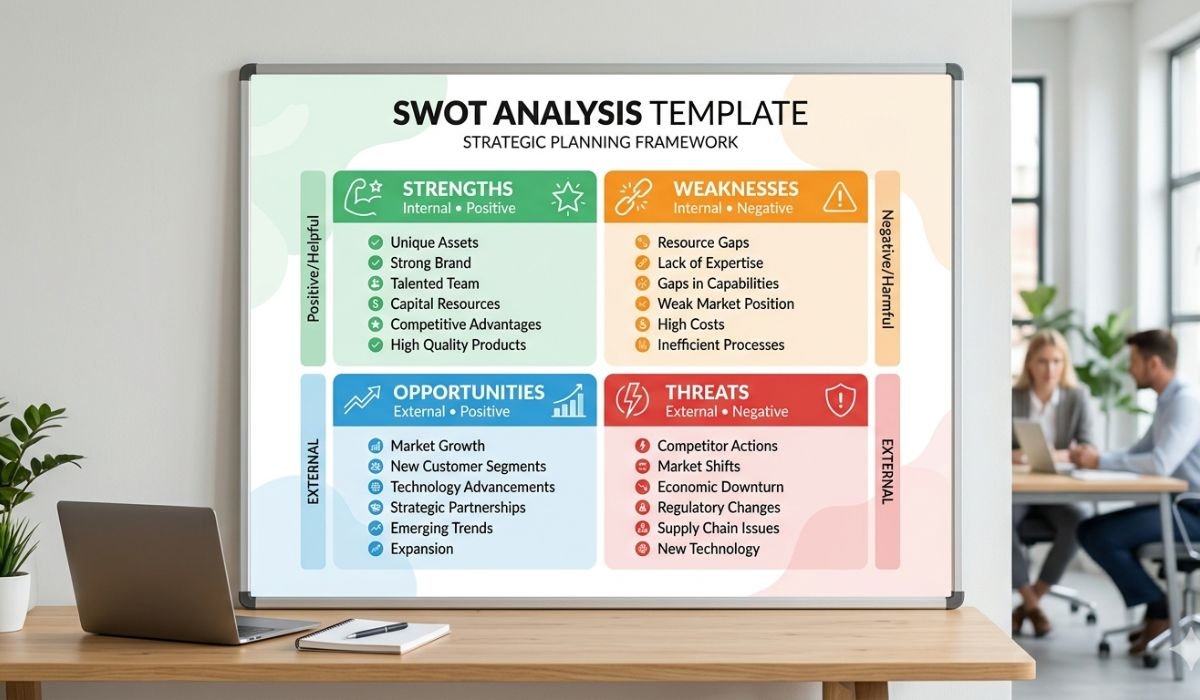
SWOT stands for Strengths, Weaknesses, Opportunities, and Threats. That is it. The idea is simple: you take whatever you are evaluating your business, a new product idea, a career decision, a marketing strategy and you look at it through these four lenses. Strengths and Weaknesses are internal. They are things within your control, things that are already true about you or your business right now. Opportunities and Threats are external. They exist in the world around you in the market, in the economy, among your competitors, in shifting customer behavior.
When I first did this exercise, I thought it would take me ten minutes and tell me nothing I did not already know. Instead, I spent nearly two hours filling out the four quadrants, and by the end I had a completely different understanding of my own business. I could see exactly where I was strong and where I was fooling myself. I could see opportunities I had been too busy to notice. And I could see threats that I had been ignoring because they made me uncomfortable.
What makes the SWOT so powerful is not any single quadrant. It is what happens when you look at all four together. That is where the real insights live in the relationship between what you are good at and what the market is asking for, between where you are weak and where the competition is strong.
The Exact SWOT Analysis Template I Use (With Explanation)
Over the years, I have tried several different formats for this exercise. I have used apps, spreadsheets, sticky notes on a whiteboard, and plain paper. What I keep coming back to is a simple two-by-two table. Clean, visual, and easy to share with a team or a business partner.
Here is the swot analysis template I personally use every time:
| Helpful to achieving the goal | Harmful to achieving the goal | |
| Internal (within your control) | STRENGTHS What do I do well? What resources do I have? What advantages do I hold over competitors? | WEAKNESSES Where do I fall short? What do I lack? What do my customers complain about? |
| External (outside your control) | OPPORTUNITIES What trends can I take advantage of? What gaps exist in the market? What is changing in my favour? | THREATS What could hurt my business? Who are my strongest competitors? What external risks am I exposed to? |
This table looks simple, but the questions inside each cell are what make it useful. Let me walk you through how I approach each one.
How to Fill Each Section Without Overthinking It
- Strengths I always start here because it is the most energising. I ask myself: what do customers consistently praise about my work? What comes easily to me that seems to be a struggle for others in my industry? What do I have whether that is a skill, a relationship, a tool, or a reputation that is genuinely hard to replicate? I try to be honest and specific. Saying “I am good at customer service” is vague. Saying “I respond to every client inquiry within two hours, which most competitors do not” is specific and real.
- Weaknesses This is the hardest quadrant to fill honestly. My natural instinct is to downplay or explain away my weaknesses. But I have learned that a weakness left unacknowledged does not disappear it just surprises you later at the worst possible time. I ask myself: what do I consistently avoid because I am not good at it? Where have I lost clients or opportunities? What would my harshest critic say about my business if they were being brutally honest?
- Opportunities Here I shift my thinking outward. I look at what is happening in my industry and ask: what trends are emerging that I could position myself to benefit from? Are there underserved customer segments? Are competitors making mistakes I could learn from? Are there new platforms, technologies, or partnerships I have not explored?
- Threats This quadrant makes people uncomfortable, but it is arguably the most important one for staying competitive. I ask myself: what could change in the market that would hurt my business? Are there new competitors entering my space? Are there regulatory changes, economic shifts, or changing customer preferences that could erode my position?
When I fill this out honestly, the template becomes a mirror. It shows me things I might have been avoiding.
SWOT Analysis Example My Real Business Walkthrough
Let me show you exactly how I applied this to one of my own projects. A couple of years ago, I was deciding whether to turn my content writing side work into a full-time business. I had been writing for clients on the side for about eighteen months, and the work was growing but slowly. I could not tell if I had a real business or just a hobby that paid occasionally.
So I sat down and ran a proper swot analysis example on my situation. Here is what I wrote:
| Helpful | Harmful | |
| Internal | Strengths: Strong writing portfolio with 15+ published samples; existing client relationships; fast turnaround time (most drafts delivered in 48 hours); niche expertise in personal finance and SaaS content | Weaknesses: No sales or outreach experience; inconsistent lead generation; underpricing my services compared to market rates; working alone with no team or backup |
| External | Opportunities: Growing demand for long-form SEO content; many businesses struggling to find reliable writers; rise of content marketing in regional markets where I had local credibility | Threats: AI writing tools disrupting the market; race to the bottom on pricing from freelance platforms; larger content agencies offering end-to-end services I could not match |
Looking at this filled-in table was a genuinely clarifying moment for me. I could see that my biggest strength fast, niche-specific writing with real samples was actually addressing a real opportunity, because businesses were hungry for reliable, specialist writers. But I could also see that I was underpricing, had no outreach process, and was exposed to the AI disruption risk more than I had admitted to myself.
This exercise helped me make two very specific decisions: I raised my rates by thirty percent, and I invested time learning cold email outreach rather than waiting for referrals. Both changes paid off within three months. The SWOT did not make those decisions for me but it made it impossible for me to keep ignoring the things I needed to do.
SWOT Analysis Examples Across Different Situations

One of the things I love about this framework is that it is not just for full business planning. I have used it in smaller, more specific situations and every time, it has helped me think more clearly. Let me share a few swot analysis examples from different contexts.
Freelancer deciding whether to specialize or stay a generalist:
A friend of mine who does graphic design was feeling burned out from taking every kind of job. She did logos, social media posts, website designs, packaging you name it. She ran a SWOT and quickly discovered that her strength was brand identity work (she had the best results and the happiest clients there), but her weakness was time management across too many different project types. The opportunity was clear: businesses were willing to pay a premium for a dedicated brand identity specialist. The threat was that if she stayed a generalist, she would always be competing on price with cheaper designers on Fiverr and Upwork. The SWOT made her case for specializing obvious in a way that her gut instinct alone never had.
Product-based small business evaluating a new product line:
I once helped a friend who runs a homemade skincare business think through whether to add a men’s grooming line. Her strengths were an existing loyal customer base and a trusted brand name. Her weakness was limited production capacity and no experience marketing to men. The opportunity was a growing market and very few natural skincare brands targeting men authentically. The threat was that larger beauty brands were increasingly moving into this space with much bigger marketing budgets. The SWOT helped her decide to launch a small trial collection first rather than a full product line a much smarter way to test the waters without overcommitting.
Service business evaluating a geographic expansion:
When my own business was doing well locally, I considered expanding to serve clients in a neighbouring city. Running the SWOT revealed that my strengths did not automatically transfer my reputation and referral network were deeply local. The opportunity was real, but the threat of competing against established players in that new market without any local credibility was significant. I delayed the expansion by six months, spent that time building relationships in the new market first, and launched when I had a foothold rather than starting from zero.
In every one of these cases, the SWOT did not produce a magical answer. What it did was slow me down enough to think through the full picture before acting.
SWOT Analysis Template for Business How to Use It Strategically
Here is the part that most guides leave out: filling in the template is only half the work. The real value of a swot analysis template for business comes from what you do with it afterward. I have seen people run a SWOT, feel satisfied that they did something strategic, and then put it in a drawer and never look at it again. That is a waste of a good exercise.
The way I use my SWOT strategically is by looking for intersections. There are four key intersections that matter most:
- Strengths + Opportunities This is where your best bets live. Where your internal advantages line up with external opportunities, you should be moving fast and investing resources. These are your highest-confidence plays.
- Strengths + Threats Here is where you use what you are already good at to protect yourself from risks. If a competitor is threatening your market share but you have a stronger customer relationship than they do, that relationship becomes your defence.
- Weaknesses + Opportunities This intersection tells you where to invest in improvement. If an opportunity exists but you cannot currently take advantage of it because of a weakness, that is a clear development priority.
- Weaknesses + Threats This is the most uncomfortable intersection to look at, but also the most important. If you have a weakness and there is a threat that could exploit it, that is where your business is most vulnerable. This is where I focus when I want to build resilience.
Turning Your SWOT Into a 90-Day Action Plan
After I map out these intersections, I build a short action table. Nothing elaborate just a way to connect the insight from the SWOT to something I will actually do.
| SWOT Finding | Strategy | Owner | Timeline |
| Strong writing portfolio + growing demand for SEO content | Pitch five new clients per month targeting SaaS companies | Me | First 30 days |
| Underpricing (Weakness) + competitor charging 2x my rates | Raise rates on new projects; test higher pricing with current clients | Me | By end of month 1 |
| No outreach system (Weakness) + opportunity in new market | Build email outreach template and send 10 cold emails per week | Me | Start week 2 |
| AI tools threatening commodity writing (Threat) | Double down on thought leadership and strategic content that AI cannot replicate | Me | Ongoing |
This table is what transforms the SWOT from a reflective exercise into an actual roadmap. I update it every quarter, which brings me to the next section.
Small Business Strategy Tips I Learned From Running SWOT Regularly
After running this exercise consistently for several years, I have picked up a handful of small business strategy tips that I wish someone had told me when I was just getting started.
The first and most important one is this: run your SWOT more than once. I used to think of it as a once-a-year activity, something I would do during annual planning and then forget about for twelve months. The problem is that markets change faster than that. Threats that were distant a year ago can become immediate. Opportunities that looked promising can close. Now I run a lighter version of the SWOT every quarter and a full version once a year. The quarterly check-in only takes about thirty minutes, but it has saved me from being blindsided multiple times.
The second tip is to do a SWOT with other people whenever you can. When I run the exercise alone, I inevitably see my strengths more clearly than my weaknesses. My blind spots stay blind. Bringing in a business partner, a trusted advisor, or even a good friend who knows my work has consistently surfaced weaknesses I would not have written down on my own. It is uncomfortable, but it is worth it.
The third tip is to be ruthlessly specific. The worst SWOT analyses I have ever seen are full of vague, generic statements. “We have a great team” is not a strength. “Our lead graphic designer has fifteen years of experience in packaging design for FMCG brands and has won two industry awards” is a strength. Specificity is what makes the SWOT actionable.
The fourth tip and this one took me a while to learn is to never ignore the Threats quadrant. I used to rush through threats because looking at them made me anxious. But the time I came closest to a serious business setback was precisely because I had glossed over a threat that was obvious in hindsight. A competitor had entered my market with a lower price point and a slicker website. I had written it down as a threat and then done nothing about it. Do not make my mistake. Every threat you identify deserves at least a sentence explaining what you would do if it materialised.
The fifth tip is to separate the exercise from the planning session. I do my SWOT on one day, sleep on it, and build the action plan the next day. The gap gives me perspective. Things that felt catastrophic when I wrote them down often look more manageable after a night’s rest. And things I was excited about sometimes lose their shine when I look at them with fresh eyes.
Common Mistakes When Using a SWOT Analysis Template
I have made most of these mistakes myself, so I share them without judgment.
The most common mistake is being too vague, which I have already mentioned. But the second most common mistake is treating the SWOT as a one-time exercise rather than a living tool. A SWOT that you filled in two years ago is not just outdated it can actually be misleading if you are making decisions based on a market reality that no longer exists.
Another mistake I see often is listing the same items in multiple quadrants. If someone puts “strong customer relationships” under both Strengths and Opportunities, that is a sign they are confusing internal assets with external conditions. Keep the quadrants clean. Strengths and Weaknesses are always internal. Opportunities and Threats are always external.
A subtler mistake is over-loading the SWOT with items. I have seen analyses with forty points in the Strengths quadrant alone. At that point, you are not doing strategic analysis you are doing a brain dump. I limit myself to a maximum of six items per quadrant. If something is not in the top six, it either does not matter enough to act on or it needs to be broken down into something more specific.
Finally, the biggest mistake of all is doing the SWOT and not connecting it to any actual decisions or actions. A SWOT that lives only on paper has no value. It only earns its place when it changes something a decision, a priority, a resource allocation, a course correction.
How Often Should You Revisit Your SWOT Analysis Template?
I get asked this question a lot, and my honest answer is: more often than you think, but less often than you fear.
My personal cadence is a full swot analysis template review once per year, tied to my annual planning season. This is the deep version where I take a couple of hours, involve anyone relevant to the business, and really interrogate each quadrant. I update my competitive landscape, revisit my assumptions, and rebuild my action plan from scratch rather than just amending the old one.
In addition to the annual review, I do a lighter thirty-minute check-in every quarter. This is not a full rebuild it is more of a pulse check. I ask myself: has anything significant changed in any of the four quadrants? Has a new threat emerged? Has an opportunity I was pursuing closed or evolved? Has a weakness I was working on improved?
Beyond the scheduled reviews, there are specific triggers that tell me it is time to pull out the SWOT regardless of where I am in the calendar. A major competitor makes a significant move. A key client churns unexpectedly. A new technology emerges that could affect my industry. A team member leaves or joins. Any of these events is a signal to pause and update my strategic picture.
The reason I emphasize revisiting the SWOT is that I have seen businesses get into trouble not because they did poor analysis at the beginning, but because they stopped analysing once they had initial momentum. The market does not stop moving just because your plan is in place.
A SWOT Analysis Template You Can Use Right Now
If you want to get started today, here is a clean, ready-to-use version of the template I have been describing throughout this article. You can copy this into any document, Google Sheet, or notebook you prefer.
| Helpful | Harmful | |
| Internal (within your control) | STRENGTHS What do I do better than anyone else? What unique resources or assets do I have? What do customers consistently praise? (List up to 6 specific items) | WEAKNESSES Where do I underperform? What resources am I lacking? What do I consistently avoid because I am not confident in it? (List up to 6 specific items) |
| External (outside your control) | OPPORTUNITIES What market trends could I take advantage of? What needs are currently unmet in my industry? What changes in technology, regulation, or behaviour could benefit me? (List up to 6 specific items) | THREATS Who are my strongest competitors and how are they growing? What external changes could hurt my business? What risks am I currently ignoring? (List up to 6 specific items) |
Once you have filled it in, give yourself a day before you start turning it into action steps. Then use the intersection framework I described earlier Strengths + Opportunities for where to push, Weaknesses + Threats for where to protect and build a short action table with real timelines and owners.
Start small. You do not need to do a SWOT on your entire business all at once. You can run it on a single decision, a specific product, or even a particular client relationship. The more specific your focus, the more actionable your output will be.
Conclusion
If I had to start over with my business from scratch, this would be the first thing I would do. Not a logo. Not a website. Not even a business plan in the traditional sense. I would sit down with this template and force myself to look honestly at where I stood, what the world around me looked like, and where the two intersected.
The swot analysis template is not a complicated tool. It is not a substitute for good judgment or deep industry knowledge. But it is one of the most reliable ways I have found to get out of my own head and see my business and my decisions more clearly. It takes the noise in my brain and organises it into something I can actually work with.
I have used it to decide when to raise prices, when to turn down a client, when to expand and when to hold back. I have used it with other business owners, in workshops, and alone at my desk at six in the morning when I was trying to figure out the right next move.
Every time, it has helped. Not by giving me the answer, but by showing me the right questions. And sometimes, asking the right questions is the most strategic thing you can do.
If you have never done a proper SWOT analysis on your business, I would encourage you to set aside a couple of hours this week and give it a real try. Use the template in this article, be honest with yourself, and see what it shows you. I think you will be surprised by what you find and even more surprised by how clearly it can point you toward what to do next.
Also Read About :- How to Start a Business Strategy