I remember sitting at my kitchen table at 11 PM, staring at a spreadsheet full of numbers that refused to make sense. My business had been running for almost eight months. We had customers. We had revenue. But every single month felt like we were sprinting on a treadmill moving fast, sweating a lot, and getting absolutely nowhere.
A friend who had been building businesses for over a decade sat across from me and asked one simple question: “What’s your strategy?”
I gave him a confident answer. I talked about my product, my marketing, my sales targets. He listened patiently, then said, “That’s not a strategy. That’s a to-do list.”
That night was the moment I genuinely started to understand how to start a business strategy not the textbook version, but the real, practical, uncomfortable version that forces you to think about where you are, where you want to go, and why anyone should care about your business at all.
If you are reading this because you are at the beginning of your business journey, or because you have been running something for a while and sense that something is missing, you are in the right place. Everything I am about to share comes from my own experience the mistakes, the pivots, and the moments where strategy finally started to click.
What a Business Strategy Actually Means (And What It Doesn’t)
Before anything else, I want to clear up the single biggest source of confusion I see among new entrepreneurs. Most people I have spoken to including myself in those early months use the words “business plan” and “business strategy” interchangeably. They are not the same thing, and the difference matters more than most people realise.
A business plan is essentially a document. It describes what your business does, who it serves, how much money it needs, and what the financial projections look like. It is largely static, mostly written for banks or investors, and once printed, it tends to live in a drawer.
A business strategy, on the other hand, is a living set of decisions. It defines how you are going to compete, what you will focus on, what you will deliberately ignore, and how you are going to create value that your competitors cannot easily copy. It is not a document it is a way of thinking and operating.
| Factor | Business Plan | Business Strategy |
| Primary purpose | Secure funding / describe the business | Guide daily and long-term decisions |
| Audience | Banks, investors, partners | You, your team, your operations |
| How often updated | Rarely (once or twice a year) | Continuously reviewed and adapted |
| Focus | What the business is | How the business will win |
| Format | Formal written document | Can be one page, a framework, or a set of principles |
| Flexibility | Relatively rigid | Intentionally adaptive |
Once I understood this distinction, everything else started to fall into place.
Why Most Beginners Confuse Tactics With Strategy
This is the trap I fell into most often. A tactic is something you do run a Google Ads campaign, post on Instagram three times a week, offer a discount to new customers. A strategy is the reason behind why those tactics make sense together.
Tactics without strategy are just expensive experiments. You might get lucky occasionally, but you have no framework for knowing which experiments to run, which to stop, and why one thing worked and another did not. I spent the first year of my business largely in tactic mode reacting to whatever felt urgent, copying what competitors seemed to be doing, and constantly second-guessing myself. It was exhausting and, looking back, mostly unnecessary.
Why I Wish I Had a Clear Strategy From Day One
There is a particular kind of frustration that comes from working incredibly hard and still feeling lost. That was my reality for the better part of a year.
I had launched what I thought was a solid product. I had a website, a social media presence, and I was putting in twelve-hour days consistently. But I had no real answer to questions like: Why would a customer choose us over a cheaper competitor? What kind of customer do we actually want to serve? What does success look like in three years, not just this month?
Because I had never sat down to answer those questions properly, every decision felt difficult. Should I lower my prices? Should I add a new product line? Should I target a different city? I had no strategic framework to run these questions through, so each one became its own mini-crisis.
The turning point came when I was forced by a potential investor, actually to write down my strategy in a single page. Not a full business plan, just the core strategic logic of the business. Why this market. Why now. Why us. How we win.
It took me an entire weekend. It was one of the most uncomfortable and clarifying experiences of my professional life. By the end of Sunday evening, I had something I had never had before a clear sense of what we were actually doing and why.
Revenue in the following quarter grew by roughly 35%. Not because I suddenly had more money or more time, but because I stopped doing the things that did not fit the strategy and doubled down on the things that did.
How to Start a Business Strategy The 7-Step Framework I Use
What follows is the exact framework I now use and help others use when figuring out how to start a business strategy from scratch. I have refined this over several years and across a few different businesses. It is not theoretical. Every step comes from doing this in the real world.
Step 1 Define Your “Why” Before Anything Else
This is not just motivational advice. Your “why” the deeper purpose behind what you are building directly shapes every strategic decision that follows.
When I say “why,” I mean: what problem are you genuinely passionate about solving, and for whom? When your strategy is built on a clear answer to this question, it becomes much easier to make trade-offs. You can say no to opportunities that look attractive but do not align, and yes to things that might look risky but make total sense given your purpose.
Write it down in one or two sentences. Not a mission statement full of corporate buzzwords. A plain, honest answer to: why does this business exist, and who would genuinely miss it if it disappeared tomorrow?
Step 2 Identify Your Target Customer With Brutal Honesty
One of the most common strategic mistakes I see and made myself is defining the target customer too broadly. “Anyone who needs X” is not a customer profile. It is a way of avoiding the discomfort of choosing.
Strategy, at its core, is about making choices. Choosing to serve one type of customer well means accepting that you will not be the perfect fit for everyone else. That is not a weakness. It is how you build something defensible.
Spend real time on this. Interview ten people who represent your ideal customer. Understand their specific frustrations, their language, what they have already tried, and why it did not work. The more specific your customer picture, the sharper your entire strategy becomes.
Step 3 Analyse Your Market and Competitors (Tools I Actually Use)
I want to be honest here: when I first heard advice about “market analysis,” my eyes glazed over. It sounded like something consultants with MBA degrees did in boardrooms, not something a small business owner needed to worry about.
I was wrong. Understanding your market does not have to be complicated, but it does have to be honest.
The tools I personally rely on are straightforward. I use a simple SWOT analysis not as a box-ticking exercise but as a genuine conversation with myself what do we do better than anyone else, where are we genuinely weak, what is changing in the market that creates an opportunity, and what could realistically threaten the business? also do a basic competitive analysis by spending serious time as a customer of my top three competitors. I use their product or service, read their reviews, notice what complaints come up repeatedly, and look for the gap they are not filling.
That gap is often where your strategy lives.
Step 4 Set Clear Strategic Goals (Not Just Revenue Targets)
Revenue targets are important, but they are outcomes, not strategies. If your only strategic goal is “hit ₹50 lakh this year,” you have a financial target, not a strategy.
Strategic goals answer a different question: what do we need to become or achieve in order for that revenue to be possible? Examples might include: becoming the most trusted provider in a specific niche, building a customer retention rate above 80%, or establishing a distribution channel that competitors do not have access to.
I personally set three strategic goals per year never more. Each one gets broken down into quarterly milestones so that progress is measurable and adjustments can be made before it is too late.
Step 5 Choose Your Competitive Advantage
This is the heart of any business strategy. Your competitive advantage is the specific reason a customer should choose you over every other option available to them including doing nothing at all.
There are broadly three ways to compete. You can be the lowest-cost option and make money through volume. You can offer something meaningfully different that a specific customer values so much they are willing to pay more for it. Or you can focus so narrowly on a specific niche that you become the obvious, dominant choice within it.
Trying to be all three at once is one of the most common strategic errors I have seen. Pick one. Be honest about which one matches your actual strengths and the market you are entering.
Step 6 Build Your Action Plan Around the Strategy
Only at this point after you have clarity on your customer, your goals, your competitive advantage should you start building your action plan. This is where tactics come in, and now they have a purpose.
Your action plan should answer: what are the three to five most important things we need to do in the next 90 days to move our strategy forward? Not twenty things. Not a wish list. Three to five concrete actions with owners, deadlines, and a clear connection back to the strategic goals you set.
Step 7 Review, Adapt, and Iterate Every Quarter
A strategy that is never reviewed is not a strategy it is a document gathering dust. Markets change, customers evolve, competitors make moves. Your strategy needs to be a living system that you return to, question, and adjust.
I run a 90-minute strategy review every quarter. I look at what has changed in the market, measure progress against my strategic goals, honestly assess what is working and what is not, and make deliberate adjustments. It is not a dramatic overhaul every time sometimes the review confirms you are on the right track. But the act of reviewing it keeps you honest and keeps your decisions connected to the bigger picture.
| Step | What to Do | Personal Tip | Time Needed |
| 1. Define your why | Write it in 1–2 sentences | Ask “would I still do this if no one was watching?” | 2–3 hours |
| 2. Identify your customer | Interview 10 ideal customers | Talk to people who have already paid, not just prospects | 1–2 weeks |
| 3. Analyse market | SWOT + competitor deep-dive | Use their product yourself before anything else | 3–5 days |
| 4. Set strategic goals | 3 goals maximum per year | Tie each goal to a “what must be true” statement | Half a day |
| 5. Choose advantage | Pick one of three models | Be honest about what you actually do better | 1 full day |
| 6. Build action plan | 3–5 priorities per quarter | Connect every tactic back to a strategic goal | Half a day |
| 7. Review quarterly | 90-minute structured review | Calendar it now before you forget | Every 90 days |
Business Strategy for Beginners The Biggest Mistakes to Avoid
If I could go back and hand my younger self a list of warnings, this section would be it. These are not hypothetical mistakes they are things I have done, watched close friends do, and seen play out painfully in businesses I have consulted with.
Mistake 1 Copying Competitor Strategy Without Context
In my first business, I spent an embarrassing amount of time studying what a successful competitor was doing and then trying to replicate it. Their pricing, their content approach, their positioning. On the surface, this seemed sensible follow what is working.
The problem is that you are copying the output of a strategy without understanding the underlying logic. That competitor may have a cost structure you do not have, a brand reputation built over ten years, or a distribution relationship that took enormous effort to develop. When you copy the tactics without the strategic context, you end up confused about why it is not working for you the way it worked for them.
Study your competitors, absolutely. But use what you learn to find the gap they are not serving, not to imitate what they are already doing well.
Mistake 2 Treating Strategy as a One-Time Document
This is perhaps the most common mistake I see. Someone takes a weekend, writes a strategy, feels good about it, and then files it away and returns to the daily grind. Six months later, the strategy is completely disconnected from reality, but because it was never reviewed, no one noticed the drift.
Strategy is a practice, not an event. The value is not in the document it is in the thinking and the regular discipline of returning to it. I have met founders running eight-figure businesses who do not have a single piece of paper with their strategy written on it. But they can articulate their strategy in perfect clarity because they think about it constantly. The document is less important than the habit.
Mistake 3 Skipping the Customer Research Phase
I skipped this in my first business because I was convinced I already understood my customer. I was the customer or so I thought. I was solving a problem I had personally experienced, so surely I knew what people wanted.
I was wrong in at least four important ways. My assumptions about pricing were off. My assumptions about where customers would find the product were off. My assumptions about the language they used to describe their problem were off. And my assumptions about what they valued most were off.
Three conversations with real potential customers would have corrected all four errors before I spent months and real money building the wrong thing. Do not skip this step. It is uncomfortable to hear that your assumptions are wrong, but it is far less costly than discovering that in year two.
How to Create a Business Strategy Plan A Practical Template
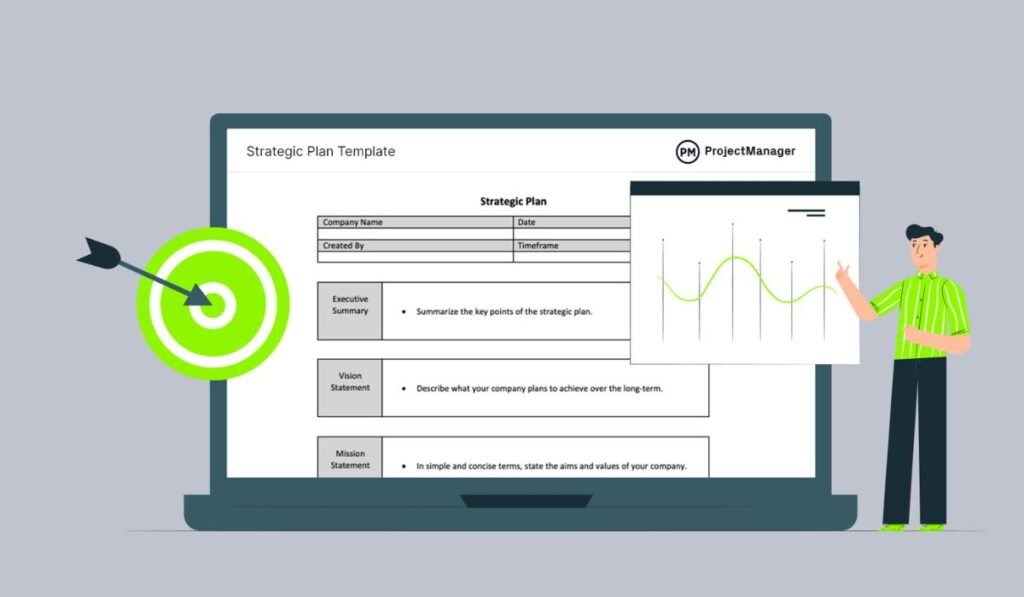
The format I am going to share here is something I developed after trying at least four different strategy frameworks and finding them either too complex for a small business or too vague to be actually useful. The goal was something I could fill in, review quarterly, and share with a team member or advisor without needing a two-hour explanation.
The One-Page Strategy Format That Changed How I Work
Everything lives on a single page. Not because strategy should be simple it often is not but because forcing yourself to fit everything onto one page forces clarity. If you cannot explain a strategic decision in a sentence, you probably do not fully understand it yet.
| Section | What to Fill In | Example |
| Our purpose | Why this business exists in one sentence | “We help first-time homebuyers in Tier 2 cities navigate the buying process without being misled.” |
| Our target customer | One specific, vivid description | “Married professionals aged 28–38, household income ₹15–25 lakh, buying their first home, overwhelmed by jargon and distrust of agents.” |
| Our competitive advantage | The one reason customers choose us | “The only advisory service that charges a flat fee, never earns commissions, and provides everything in writing.” |
| Strategic goals (this year) | 3 goals maximum | 1. Reach 200 paying clients. 2. Build NPS above 70. 3. Launch referral programme. |
| What we will NOT do | Deliberate exclusions | We will not serve property investors. We will not offer resale properties. We will not take commissions. |
| Key priorities this quarter | 3–5 actions | 1. Hire first full-time advisor. 2. Launch LinkedIn content series. 3. Build onboarding process. |
| How we measure success | 2–3 metrics that matter | Monthly paying clients, NPS score, referral rate. |
The “what we will not do” row is the one most people skip, and it is arguably the most important. Strategy is as much about what you decide not to do as what you decide to pursue. When you write down your exclusions explicitly, you give yourself and your team permission to say no without guilt.
How to Keep Your Plan Alive and Not Let It Collect Dust
Print it. Put it somewhere you see every day. Review it at the start of every week for ten minutes. Ask yourself: are the decisions I made this week aligned with this strategy or not? That ten-minute weekly check-in is worth more than any elaborate planning retreat.
The Tools and Resources I Actually Use to Build Strategy
I want to talk about tools the way a practitioner would not as a list of frameworks to know about, but as things I have genuinely found useful and the specific way I use them.
The SWOT analysis gets a bad reputation because it is so often done poorly filled with vague generalisations that do not lead to any real decisions. The way I use it is as a structured conversation, not a box-filling exercise. For each of the four quadrants, I ask a forcing question. For Strengths: “What do we do that a competitor would struggle to replicate in the next twelve months?” For Weaknesses: “If a smart competitor wanted to attack us, where would they aim?” For Opportunities: “What is changing in the market right now that plays to our specific strengths?” For Threats: “What single development could make our current model irrelevant?”
Porter’s Five Forces is another framework I found intimidating at first because it is taught in MBA programmes with a lot of complexity. But the underlying questions are actually very practical for a small business. How easy is it for a new competitor to enter your market, How much power do your suppliers have over your costs? How much power do your customers have to push your prices down? The answers to these questions shape important strategic decisions around pricing, partnerships, and market positioning.
For free and low-cost tools, I rely heavily on Notion for keeping my one-page strategy document live and linked to my quarterly action plan. Miro is genuinely useful for the early visual mapping phase when you are trying to organise your thinking about customers and market positions. And Google Sheets remains my favourite tool for tracking the three or four metrics that actually tell me whether my strategy is working stripped of vanity metrics, just the numbers that connect directly to strategic goals.
Step by Step Business Strategy Guide Putting It All Together
Knowing the individual steps is one thing. Understanding what the full process actually looks like in practice week by week, month by month is what separates the people who build real strategies from those who go through the motions.
What Your First 30 Days of Strategy-Building Should Look Like
The first 30 days are entirely about gathering honest information and fighting the urge to jump straight into planning. In weeks one and two, the focus should be on customer conversations ten interviews minimum, ideally fifteen. Not surveys, not form fills. Real conversations. In weeks three and four, you move to competitive analysis and writing your first draft of the one-page strategy. You will not get it right the first time, and that is completely fine. The goal at this stage is to have something written down that you can challenge and improve.
How to Know If Your Strategy Is Actually Working
A strategy that cannot be measured is a belief, not a strategy. You need two or three specific metrics that tell you whether the strategy is delivering. These should be metrics you can check monthly, not just at the end of the year. If you have chosen differentiation as your competitive advantage, for example, your metrics might include average revenue per customer (if differentiation is working, customers are willing to pay more), customer referral rate (differentiated businesses get talked about), and customer retention (people come back when they value what you offer specifically).
If the numbers are not moving in the right direction after two full quarters, the strategy needs to be reviewed not just the tactics. This is the discipline that separates strategic thinking from wishful thinking.
| Timeline | Focus Area | Key Deliverable |
| Days 1–14 | Customer and market research | Notes from 10+ customer interviews, competitor analysis |
| Days 15–21 | Internal analysis | Completed SWOT, honest capability assessment |
| Days 22–30 | First strategy draft | Completed one-page strategy template |
| Month 2 | Strategy pressure-testing | Share with 2–3 trusted advisors, revise based on feedback |
| Month 3 | Action plan launch | 3–5 priorities identified, owners assigned, tracking begun |
| End of Quarter 1 | First strategy review | Measure progress, identify what is working, adjust |
Real Examples What a Simple Business Strategy Looks Like in Practice
Abstract frameworks are easier to absorb when they connect to something recognisable. Let me share two brief examples drawn from real situations I have been close to with some details changed for privacy.
The first is a woman I know who runs a home-baked goods business from Delhi. In her first year, she was trying to sell to everyone corporate orders, individual customers, event catering, regular doorstep delivery. She was always busy but always stressed, and her margins were poor because every order was slightly different and hard to systematise. When she sat down to define her strategy, she made a single decisive choice: she would focus exclusively on corporate gifting specifically for Diwali and other festive seasons and would offer only her five best-selling products in premium packaging. Within eighteen months she had doubled her revenue while working fewer hours, because her operations had become streamlined, her customer acquisition was focused, and she had built a genuine reputation in a specific niche.
The second is a freelance digital marketer I worked with who was charging mid-market rates and struggling to differentiate himself from hundreds of other freelancers. His strategy shift was to stop offering general marketing services and to focus exclusively on helping D2C skincare brands in India with their Meta advertising. He became genuinely expert in that one narrow space, started writing about it publicly, and within a year was charging three times his previous rates. Same skills, sharper strategy.
In both cases, the transformation was not about working harder or spending more on marketing. It was about making a clear strategic choice choosing a specific customer, a specific offering, and a specific competitive position and then having the discipline to stick to it.
Common Questions I Get Asked About Business Strategy
How long does it take to build a business strategy?
The first draft of a one-page strategy can be completed in a weekend if you already have some knowledge of your market and customer. But a strategy that is genuinely grounded in real customer insight and competitive analysis will typically take three to four weeks to develop properly including time for customer interviews, competitive research, and honest internal reflection. Do not rush this process. A week of thinking carefully is worth far more than a strategy written in an afternoon that you never fully believe in.
Do I need a business strategy if I am a solo entrepreneur?
Absolutely, and perhaps more so than a larger team. When you are operating alone, every hour you spend is precious. Without a clear strategy, it is very easy to spend your limited time on work that feels productive but does not actually move your business forward. Strategy is how you decide where your energy goes and for a solo operator, that decision is critical.
Can a business strategy change midway through the year?
Yes, and sometimes it must. Markets shift, new information emerges, and sometimes something you believed about your customer or your competitive position turns out to be wrong. The key distinction is between changing your strategy because of genuine new insight versus changing it because things feel difficult. Difficulty is not a sign your strategy is wrong. But a real change in market conditions or customer behaviour is a legitimate reason to adapt.
What is the first step in how to start a business strategy?
In my experience, the true first step in how to start a business strategy is not picking a framework or filling in a template it is honest self-reflection about what kind of business you are actually trying to build and for whom. Before any tool or methodology is useful, you need a clear answer to: who is this for, why would they choose us, and what does winning actually look like? Everything else follows from those three questions.
Conclusion
Looking back at that night at my kitchen table staring at a spreadsheet that made no sense I can see clearly now what was missing. It was not effort. was not intelligence. was not even experience. was strategy.
Having a clear strategy did not make everything easy. Business is never easy. But it made everything more intentional. Decisions became easier because there was a framework to run them through. Saying no to the wrong opportunities became less painful because I knew what the right ones looked like. And the team around me small as it was became more focused because everyone understood what we were actually trying to achieve and why.
If you take one thing from everything I have shared, let it be this: you do not need a perfect strategy. You need an honest one. Something real, written down, built on actual knowledge of your customer and your market, that guides how you spend your time and where you focus your energy.
That is how to start a business strategy that actually serves you not a document to file away, but a living set of decisions you return to, question, and trust.