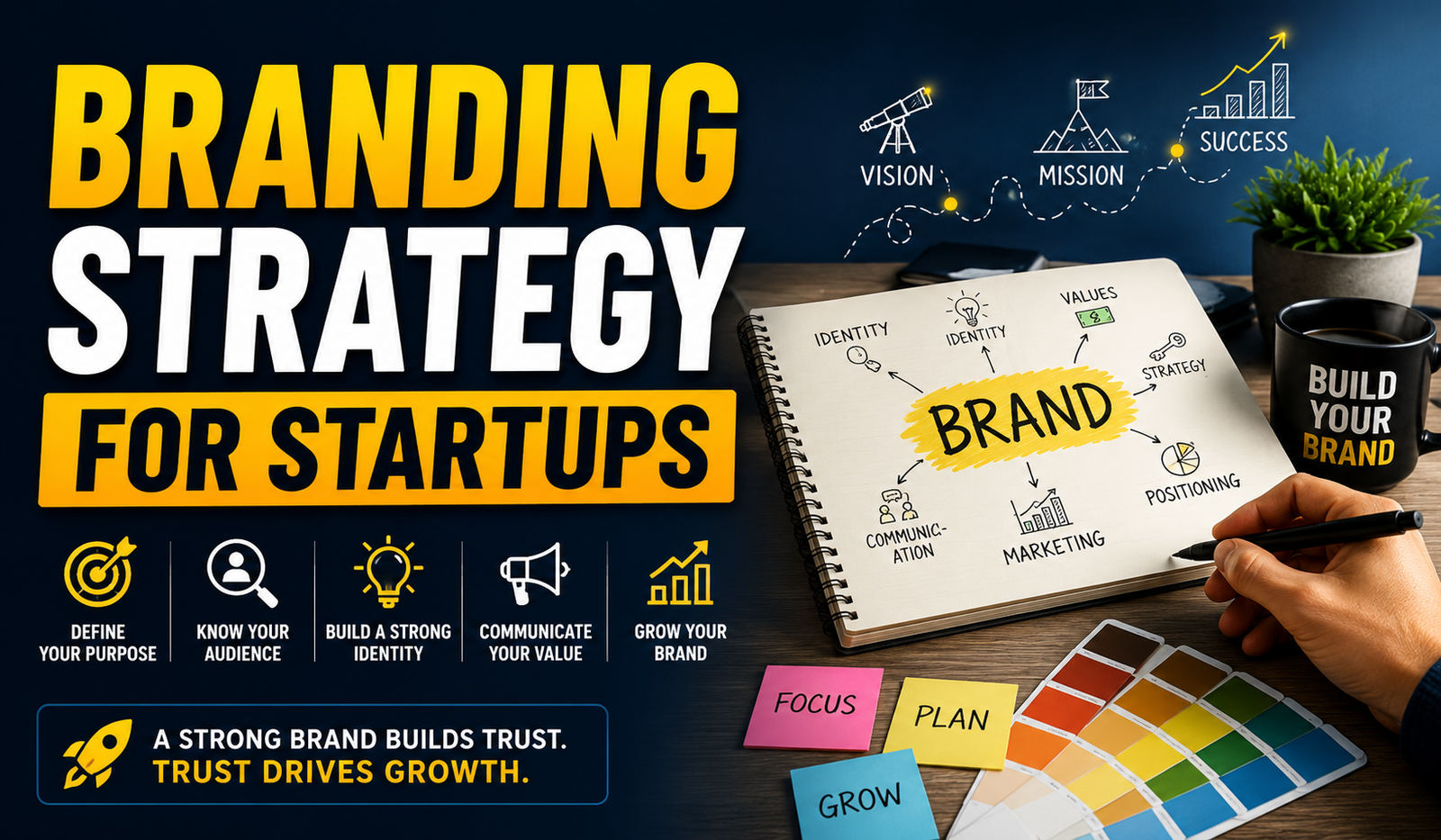
I still remember the exact moment I realised I had a serious problem. It was about eight months into running my startup, and a potential investor asked me one simple question: “What does your brand stand for?” I had a beautiful logo. I had a colour palette. I had a website that I was genuinely proud of. But when that question landed in front of me, I had absolutely nothing. I stumbled through a vague answer about quality and customer focus, and I watched her interest visibly fade. That evening, I went back to my desk and started from scratch on the most important thing I had been ignoring a real branding strategy for startups that could actually hold up under pressure.
Here is what I have learned, and this is purely from personal experience: most startup founders confuse branding with design. They think that once they have a logo and a colour scheme, they are done. I was guilty of that exact mistake. Branding is not your logo. Branding is not your font choice. Branding is the total feeling someone gets when they interact with everything your company does. It is the promise you make, the personality you project, and the consistency you maintain across every single touchpoint.
In this article, I am going to walk you through everything I did the right moves, the costly mistakes, and the seven-step framework I eventually built from the ground up. This is not a theoretical guide. Everything I am sharing here is something I personally tried, tested, and refined while building my own startup from zero. If you are a founder who is figuring out where to even begin, I promise this will give you more clarity than anything else you read today.
What Branding Actually Means for a Startup (And What It Doesn’t)
Let me be direct with you because I wasted nearly a year getting this wrong. When I launched my startup, I spent weeks obsessing over logo variations, debating shades of blue, and hunting for the perfect font on Google Fonts. I genuinely believed that was branding. It is not.
Branding is the perception that lives in your customer’s mind. It is the answer to the question: “What do people say about you when you are not in the room?” Your logo is a visual trigger. Your colours create mood. But your brand is the sum total of every experience, every message, every interaction someone has had with your company.
I learned this the hard way when I had two competing products in my niche with nearly identical visual identities to mine. What separated the one that won from the one that failed was not design at all. It was clarity of purpose, consistency of voice, and the emotional connection they had built with their audience. That realisation completely changed how I approached building my startup’s identity.
Branding, at its core, is a triangle of three things: perception, promise, and consistency. Perception is what people already think of you. Promise is what you guarantee to deliver. Consistency is how reliably you show up and deliver on that promise. When all three align, you have a brand. When even one is missing, you have a visual identity without substance.
Why Your Branding Strategy for Startups Needs to Come Before Marketing
This is the order of operations that almost every founder gets wrong, and I was no exception. I spent real money on Instagram ads in my third month of business. I hired a freelancer to run Google campaigns. I even did some influencer outreach. And the results were genuinely terrible not because the channels were wrong, but because I had no brand underneath the marketing. I was pouring water into a bucket full of holes.
Here is what I now tell every founder I mentor: marketing amplifies what already exists. If what exists is unclear, inconsistent, or undefined, marketing just amplifies the confusion. You can have the best targeting in the world, but if someone clicks on your ad and arrives at a brand that has no clear personality or promise, they leave. And in my experience, they rarely come back.
Brand-first thinking means you define who you are, what you stand for, who you are speaking to, and how you sound before you spend a single rupee or dollar on paid acquisition. Once I stopped all paid activity and spent three focused weeks building out my brand foundations, everything changed. My organic content started performing better. My email open rates went up. And when I eventually returned to paid ads, my conversion rate was more than double what it had been before.
The sequence matters more than most people realise. Brand first. Then content. Then distribution. Then paid amplification. Anything else and you are building on sand.
The 7-Step Branding Framework I Built From Scratch
This framework did not come to me all at once. I built it step by step, learning from failures, reading obsessively, talking to customers, and slowly figuring out what actually moved the needle. I am sharing it here in the order I wish I had done it from day one.
Step 1 Define Your Brand Purpose (The “Why”)
I was sitting in a small coffee shop near my office when I finally figured out my startup’s real “why.” I had read Simon Sinek’s work on the Golden Circle the idea that truly powerful brands start with why they exist, then explain how they do it, and finally describe what they sell. Most companies do this completely in reverse. They talk about features and products and pricing without ever explaining the deeper reason they show up every day.
I took a napkin and wrote three questions: Why do I care about this problem? Who suffers because this problem exists? What would the world look like if this problem was solved? The answers to those three questions became the foundation of everything my pitch, my content, my team culture, and my customer conversations.
My honest advice is this: do not rush through this step. I see founders spending hours on their Canva designs and fifteen minutes on their brand purpose. Flip that ratio. Your “why” is the compass that every other decision points back to. When you are confused about how to respond to a customer complaint, your why guides you. When you are unsure whether to partner with someone, your why tells you. It is the most important document your brand will ever have.
Step 2 Know Your Target Audience Deeply
I used to think my product was for “ambitious professionals between 25 and 45.” That is not an audience. That is a demographic. There is a massive difference, and I did not understand that until I started doing real customer interviews.
I personally spoke to over forty potential customers in my first two months. Not surveys actual conversations. I asked them about their daily frustrations, what they had already tried, what they wished existed, and where they spent their time online. From those conversations, I built detailed audience personas that went far beyond age and income.
Below is the exact persona template I used, which I still use today whenever we enter a new market segment:
| Persona Element | Details to Define |
| Name & Age | Give them a real name and specific age it makes them feel human |
| Primary Pain Point | The one problem keeping them up at night |
| What They Want | The outcome they are actually chasing, not just the solution |
| Where They Hang Out | Specific platforms, communities, events, and media they consume |
| What They Distrust | Objections and red flags that make them hesitate to buy |
| How They Make Decisions | Solo, with a team, research-heavy, or impulse-driven |
Once I had these personas built out, my messaging became so much sharper. I stopped trying to speak to everyone and started speaking directly to someone. That shift alone improved my email click-through rates by nearly sixty percent.
Step 3 Study Your Competitors Without Copying Them
I spent one full week doing a deep competitive brand audit. I looked at every competitor’s website, social media presence, content strategy, customer reviews, and even the language they used in their email newsletters. But I was not looking for things to copy. I was looking for gaps places where the market was underserved, voices that were missing, and positions that nobody had claimed yet.
This is the competitive brand analysis table I built during that process:
| Brand | Tone of Voice | Visual Style | Core USP | Biggest Weakness |
| Competitor A | Corporate, formal | Clean, minimalist | Enterprise reliability | Feels cold and distant |
| Competitor B | Casual, trendy | Bold, colourful | Youth appeal | Lacks depth and credibility |
| Competitor C | Educational, helpful | Simple, approachable | Expert positioning | Too much content, no personality |
| My Brand (Target) | Warm, personal, experienced | Professional but human | Real stories, real results | Still being built |
When I completed this exercise, the gap became obvious. Every competitor was either too corporate and cold, or too casual and lightweight. Nobody was occupying the space of “experienced founder speaking honestly from real experience.” That became my position, and it has served me well ever since.
Step 4 Build Your Brand Voice and Personality
Before I touched a single design file after my reset, I spent two days defining my brand voice. I chose three words: honest, experienced, and human. Every piece of content I have written since then gets filtered through those three words. If something sounds too salesy, it fails the honest test. If it sounds too basic, it fails the experienced test. If it sounds robotic or formal, it fails the human test.
Brand voice is the personality that shows up in everything you write your website copy, your social captions, your email subject lines, your customer service responses, even your 404 error page. I have seen startups with stunning visual identities completely undercut themselves with generic, lifeless copy that could have been written by anyone for anyone.
My recommendation is to write down ten sentences that feel like your brand, and ten sentences that definitely do not. Share them with your team. Discuss why each one does or does not fit. That conversation will reveal more about your brand personality than any brand workshop ever could.
Step 5 Create a Visual Identity That Reflects Your Brand
I want to be completely honest here because I made an expensive mistake. In my first round of branding, I spent a significant amount of money on a design agency that produced beautiful work that had absolutely nothing to do with my brand purpose or audience. It looked impressive. It meant nothing.
When I rebuilt, I started with my brand voice and my audience personas and worked backwards to the visual identity. Every design decision the colour palette, the typography, the photography style, the illustration approach was made to serve the brand strategy, not the other way around.
For early-stage startups, I personally used a combination of tools that kept costs reasonable without sacrificing quality. I used Canva Pro for social media and marketing assets, hired a single skilled freelance designer for the core brand identity work, and used Looka for initial logo concepts before refining them. The total investment was a fraction of what agencies charge, and the result was far more aligned with my actual brand because I was deeply involved in every decision.
Step 6 Build a Brand Story That People Remember
Of everything I have done to build my brand, storytelling has been the single most powerful tool. People do not remember features. They remember stories. And the most powerful story you have as a startup founder is your own why you started, what you struggled with, what you learned, and where you are going.
I use a simple three-part structure for every brand story I tell:
| Story Element | What It Covers | Why It Matters |
| The Problem | The pain point or gap you personally experienced or witnessed | Creates immediate identification with your audience |
| The Journey | What you tried, what failed, what you discovered along the way | Builds credibility and shows authenticity |
| The Transformation | Where you are now and what you can help others achieve | Creates aspiration and a reason to engage |
I used this structure in my website About page, my LinkedIn posts, my investor pitches, and my customer onboarding emails. Every time I told the real story including the failures and the confusion I got a deeper response than when I talked about features or results. People connect with people, not products.
Step 7 Stay Consistent Across Every Touchpoint
This is where most startups fall apart, and it is the step that took me the longest to get right. Consistency does not just mean using the same logo everywhere. It means that every single place a customer encounters your brand from your Twitter bio to your invoice template to the way you respond to a negative review feels like it comes from the same company with the same values and the same voice.
The touchpoints most startups ignore completely are the ones that matter most: email signatures, error pages, onboarding messages, customer support responses, packaging and delivery notes, and even how your team speaks about the company in casual conversations. These are the moments that either build or destroy brand trust.
One of the most practical branding tips for startups I can offer is this: create a simple brand guideline document before you hire your first team member. It does not need to be fifty pages. Mine was eight pages when I started. It covered our logo usage, our colour palette, our typography, our voice and tone with examples of right and wrong, and our core brand values. Every new person who joined the team read it on day one.
How I Integrated Branding Into My Marketing Strategy for Startups
Once my brand foundations were solid, integrating them into my marketing became remarkably natural. The brand voice I had defined made content creation faster because I always knew how to sound. The audience personas I had built made channel selection obvious because I knew exactly where my people spent their time. The brand story I had crafted gave me an endless supply of authentic content ideas.
My content strategy was built entirely around my brand voice. I wrote long-form LinkedIn articles from personal experience. I created Instagram carousels that taught practical concepts in my brand’s visual style. I published a weekly email newsletter that felt like a letter from a trusted friend rather than a marketing broadcast. Every piece of content reinforced the same brand honest, experienced, and human.
What I discovered is that a clear brand makes you a better marketer almost automatically. When you know who you are and who you are speaking to, every content decision becomes easier. You stop second-guessing your captions and start publishing with confidence. You stop chasing every new platform and start doubling down on the ones where your audience actually lives.
The marketing strategy for startups that I now believe in completely is simple in principle but requires real brand clarity to execute: own one core message, master one primary content format, dominate one distribution channel, and only expand once you have proven traction. Brand clarity is what makes that focus possible. Without it, you end up trying to be everywhere for everyone, and you end up nowhere for anyone.
I eventually added paid advertising back into my strategy, but only after my organic brand-led content had already started building genuine community and trust. By that point, paid ads were amplifying something real rather than trying to manufacture something artificial. The difference in results was remarkable.
The Biggest Branding Mistakes I Made (So You Don’t Have To)
I want to spend some honest time on my failures here because I think they are more instructive than my successes.
Rebranding too early out of insecurity. About four months in, I started feeling like my brand was not working. The truth was that my marketing was not working because my brand had not been given enough time to build recognition. I triggered a full rebrand new name consideration, new colours, new everything and it set me back three months and confused the small audience I had started to build. Consistency over time is how brands build equity. Changing direction every few months resets the clock every time.
Ignoring internal brand culture. I focused so heavily on external branding that I completely neglected the internal dimension. My team did not understand what the brand stood for. They were not embodying the values in their customer interactions. One conversation with an early customer revealed that our support emails sounded nothing like our marketing. The gap between what we projected and what we delivered was damaging trust quietly. Brand culture starts inside the company, not outside it.
Chasing competitor aesthetics instead of owning our own identity. There was a period where I kept tweaking our visual identity every time a well-funded competitor launched a new look. I was letting their design decisions drive my brand instead of letting my brand strategy drive my design. The result was an inconsistent visual identity that never felt truly ours. The day I stopped looking at competitors and started looking at our own brand purpose for design direction was the day our visual identity finally clicked.
Measuring vanity metrics instead of brand recall. I spent months tracking follower counts and likes while completely ignoring the metrics that actually told me whether my brand was working: unprompted brand mentions, direct search volume for my company name, referral traffic from personal recommendations, and email reply rates. Those are the signals of brand health. Follower counts are the signal of content performance, which is a very different thing.
How Long Does It Take to Build a Strong Brand as a Startup?
I want to give you an honest answer here rather than a motivational one. Building a brand that people recognise, trust, and actively seek out takes time. From my own experience and from watching other founders, I would say that meaningful brand traction starts to show somewhere between six and eighteen months of consistent, strategic effort.
Here is the realistic timeline I experienced and now share with every founder I work with:
| Phase | Timeframe | What You Are Building | Key Milestone |
| Foundation | Month 1–3 | Brand strategy, voice, visual identity, core story | Brand guideline document completed |
| Content & Presence | Month 3–6 | Consistent content output, community building, SEO groundwork | First unprompted brand mentions |
| Recognition | Month 6–12 | Audience growth, referral traffic, brand association forming | People finding you by name search |
| Equity | Month 12–18 | Trust built, word of mouth active, brand doing sales work for you | Customers citing brand as reason for buying |
Brand equity in the early stages does not look like Apple or Nike. It looks like a potential customer saying “I’ve been following you for a while” before they even get on a sales call. It looks like someone sharing your content and adding their own endorsement. It looks like investors who already know your name before you pitch them. Those are real signs of a branding strategy for startups that is actually working.
Quick Branding Tips for Startups Who Are Just Getting Started
Before I close, I want to share a handful of practical branding tips for startups that I wish someone had given me on day one. These are not grand strategies they are the small, specific things that made a real difference in how my brand was perceived and experienced.
Start with a positioning statement before you design anything. Write one sentence that captures who you serve, what you offer, and why it matters differently than what already exists. Mine took eleven drafts. By the time I had it right, every design decision became easier because there was a clear brief to work from.
Use your founder story as your primary brand asset. In the early days of a startup, the founder is the brand. Your personal credibility, your authentic story, and your visible expertise do more brand-building work than any marketing campaign. I published consistently on LinkedIn as myself before we had significant company-level brand recognition, and that personal brand lifted the company brand significantly.
Make your brand easy to experience, not just easy to understand. I see too many startups that describe their brand values beautifully but make them impossible to feel in real interactions. If you say you are warm and human, your customer service emails need to be warm and human. If you say you are innovative, your product experience needs to feel innovative. Close the gap between the brand you describe and the brand people actually encounter.
Build a swipe file of brand moments you admire. I kept a folder of screenshots emails, social posts, website copy, packaging from brands whose communication I admired. Not to copy them, but to use them as a reference point when I was trying to understand what good felt like. Over time, I developed a much sharper instinct for what was on-brand and what was not.
Audit your brand touchpoints every quarter. Set a recurring reminder to go through every customer-facing element of your brand and ask whether it still reflects who you are and what you stand for. Brands drift without maintenance, and small inconsistencies compound over time into a confusing overall impression. A quarterly audit keeps everything sharp and aligned.
Conclusion
Looking back at that conversation with the investor who asked me what my brand stood for, I am genuinely grateful it happened early. It forced me to stop treating branding as a cosmetic exercise and start treating it as the strategic foundation that everything else depends on.
The most important thing I want you to take from everything I have shared is this: start with purpose, not design. Get clear on why you exist, who you serve, and what makes your presence in the market meaningful. Everything else the visuals, the content, the campaigns, the channels will flow from that foundation with surprising ease.
Building a real branding strategy for startups is not a one-time project. It is an ongoing practice of staying true to your core identity while evolving in response to what you learn from your market. The founders who build the strongest brands are not the ones with the biggest budgets. They are the ones with the clearest sense of who they are and the discipline to express that consistently, day after day, across every single thing they do.
I would love to know where you are in your own branding journey. Drop your biggest branding challenge in the comments I read every one of them, and I often find the best insights come from the questions founders are brave enough to ask out loud.
Frequently Asked Questions
What is a branding strategy for startups?
A branding strategy for startups is a deliberate plan that defines who your company is, what it stands for, who it serves, and how it consistently communicates and presents itself across all touchpoints. It goes far beyond logos and colours to include your brand purpose, voice, story, and the emotional promise you make to your customers.
How much should a startup spend on branding?
In my experience, early-stage startups should invest more time than money in branding. The strategy work purpose, positioning, audience research, and voice costs nothing but focused effort. For visual identity, a skilled freelance designer in the range of $500 to $2,000 is usually sufficient for a startup’s first professional brand. Save the bigger budget for when you have validated your positioning with real customers.
When should a startup start building its brand?
Ideally, before you build your product or write your first line of marketing copy. In practice, the moment you decide to launch a startup is the right time to start thinking about brand purpose and positioning. Even a rough brand foundation is infinitely better than no foundation at all when it comes to making consistent decisions about product, marketing, and culture.
What is the difference between branding and marketing for startups?
Branding is who you are. Marketing is how you tell people about who you are. Your brand is the foundation the identity, the values, the personality, the promise. Your marketing is the activity that carries that brand into the world through specific channels, campaigns, and content. Branding without marketing is invisible. Marketing without branding is forgettable. They work together, but branding must come first.
Can a startup build a strong brand without a big budget?
Absolutely, and some of the most distinctive startup brands I have encountered were built with almost no budget. What they had instead was clarity of purpose, consistency of voice, and the courage to tell a genuine story. Budget helps you move faster and look more polished, but it cannot substitute for a real point of view and the discipline to express it consistently. Start with strategy, and the design can follow when the budget allows.
Also Read About :- How Business Strategy Software Tools