I still remember the exact moment I realized I had been running my startup completely blind. We were six months in, the team had grown to eight people, we were spending money every single day, and when someone asked me a simple, reasonable question “What’s the plan for the next quarter?”, I had nothing concrete to say. I had ideas, sure. I had energy, ambition, and a whiteboard full of half-baked diagrams. But an actual plan? Not even close.
That moment was embarrassing. More than that, it was expensive. We had wasted two months pursuing a product direction that had no real strategic basis. We were moving fast, but we were moving in circles.
That experience is what pushed me to go deep on strategic planning tools for startups not the corporate kind that consultants sell to Fortune 500 companies, but the lean, practical frameworks that actually work when your runway is short, your team is small, and every decision carries real weight. I spent months testing different tools, reading everything I could find, applying frameworks to real business decisions, and watching what moved the needle and what just added noise.
What you’re going to read in this article is not a textbook summary. It is everything I personally learned the wins, the wasted afternoons, the tools I abandoned after one use, and the ones I still use every single quarter without fail. I am going to walk you through the strategic planning tools for startups that genuinely changed how I think and operate, and I am going to be honest about the ones that looked great on paper but fell flat in practice.
Strategic Planning for Startups Is Not the Same as for Enterprises
One of the first mistakes I made when I started learning about strategic planning was reading material designed for large organizations. I picked up frameworks that assumed I had a dedicated finance team, stable revenue, and time to run month-long planning workshops. None of that applied to me. When you are a startup founder, your planning horizon is shorter, your data is messier, and your priorities can shift overnight because of a single customer conversation or a competitor’s product launch.
Enterprise planning is about optimization how do we squeeze more efficiency out of a system that already works? Startup planning is about survival and direction how do we find the right path before we run out of time and money? These are fundamentally different questions, and they require different tools.
What I eventually realized is that the best strategic planning tools for startups are the ones that help you make better decisions faster, with less information than you would like to have. They are not about producing beautiful documents. They are about forcing clarity.
The Three Phases Where Planning Tools Matter Most
The tools that serve me well at one stage of growth have often been useless at another. Over time, I started organizing my thinking around three distinct phases, and this has made it much easier for me to pick the right tool for the right moment.
The first phase is pre-launch, where the entire job is validation. You do not yet know if your idea is worth building. The tools that help here are the ones that force you to articulate assumptions and test them quickly. The second phase is post-launch traction, where you have some data but not enough to feel confident. This is where goal-setting and measurement frameworks start earning their keep. The third phase is scale, where complexity grows faster than your team can handle, and you need systems that translate strategy into execution across multiple people and functions.
I will reference these phases as I walk through each tool, because context matters enormously. A framework that is perfect for phase one can actually slow you down in phase three.
The Strategic Planning Tools for Startups That I Keep Coming Back To
Let me be upfront about something. Over the years, I have tried more frameworks than I care to admit. I have bought courses, attended workshops, and read stacks of business books. Most of it was forgettable. What follows are the tools that survived that filtering process the ones I still actively use or recommend without hesitation.
The Business Model Canvas
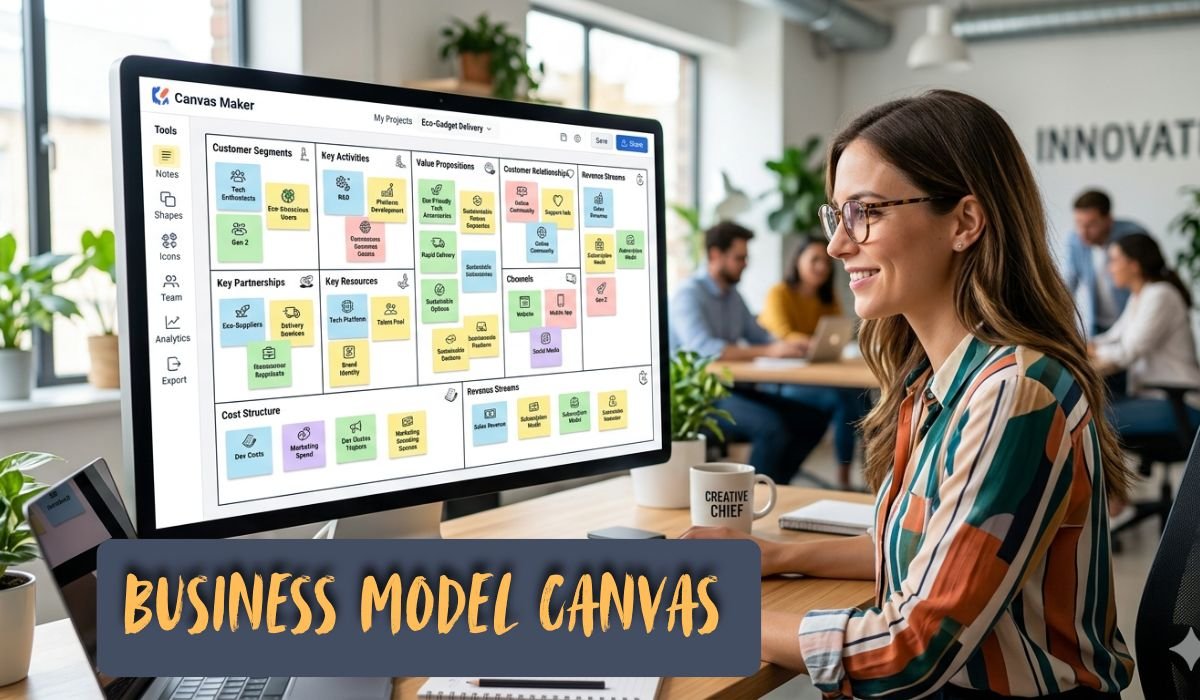
The first time I encountered the Business Model Canvas, I thought it was too simple to be useful. It is just a one-page template with nine boxes value proposition, customer segments, channels, customer relationships, revenue streams, key resources, key activities, key partnerships, and cost structure. I remember thinking, “This is what people pay consultants to teach them?”
I was wrong. The power of the Business Model Canvas is not in the template itself it is in the conversation it forces. When I sat down with my co-founder and we tried to fill in each box honestly, we immediately discovered that we had very different assumptions about who our customer actually was. We were three months into building a product, and we had never explicitly aligned on this. The canvas surfaced that in about twenty minutes.
What I now do with the Business Model Canvas is use it at the very beginning of any new product or initiative, before writing a single line of code or creating a single piece of content. I fill it in with the team, I put it up on the wall, and I treat it as a living document. When an assumption changes and it will change I update the canvas. It is the closest thing I have found to a shared mental model that everyone on the team can refer to.
The canvas works best in the pre-launch and early traction phases. Once you are past product-market fit, its value diminishes, and you need tools with more operational depth.
OKRs Objectives and Key Results
I will confess that my first experience with OKRs was a disaster. I had read John Doerr’s book, watched a few talks, and felt confident I understood the framework. I set three objectives for the quarter, wrote out four or five key results per objective, and shared them with the team with great enthusiasm.
By the end of the quarter, we had technically “hit” some numbers but accomplished almost nothing that actually mattered. The key results I had written were easy to game they measured activity rather than outcomes. I had confused output with impact, which is one of the most common OKR mistakes I see founders make.
The second time around, I rewrote our OKRs from scratch with one rule: every key result had to describe a change in the world, not just a task completed. Instead of “publish 10 blog posts,” I wrote “organic traffic increases by 40% from content.” That small reframe changed everything. Suddenly, my team was thinking about whether their work was actually producing results, not just checking boxes.
OKRs are also where I first started seriously thinking about KPI metrics for business. The key results in an OKR framework are essentially the KPIs you decide to care about most in a given period. The connection is direct and important. Your OKRs tell you what you are trying to achieve; your KPIs tell you whether you are actually getting there. I will go deeper on KPIs in a later section, but it is worth noting here that OKRs without a solid KPI measurement system are just wish lists.
I use OKRs on a quarterly cadence. I set them as a team, I review progress weekly in a brief stand-up, and I do a formal retrospective at the end of each quarter. The retrospective is the part most founders skip, and it is the part that made the biggest difference for me.
SWOT Analysis The Right Way
Most people do SWOT wrong, and I know this because I did it wrong for years. The standard version looks like this: gather your team, put four boxes on a whiteboard, spend an hour brainstorming Strengths, Weaknesses, Opportunities, and Threats, and then leave the room feeling productive but with no actual decisions made.
The problem with how most people run SWOT is that it stops at identification. You list the things, you feel like you have been thorough, and then nothing changes. The tool is not the diagnosis it is what you do with the diagnosis that matters.
What I now do differently is run SWOT as a decision-forcing exercise. After identifying the four categories, I ask one more question for each: “Given this strength, weakness, opportunity, or threat, what is the one strategic decision we should make this quarter?” That question is what transforms SWOT from a passive inventory into an active planning tool.
I also run SWOT with real data whenever possible. Instead of relying on gut feelings about our competitive position, I pull customer interview notes, churn data, and market research. It takes longer to prepare, but the output is far more useful.
The Balanced Scorecard
Of all the tools I have used, the Balanced Scorecard is the one that took me the longest to appreciate. It was designed in the early 1990s for large organizations, and when I first tried to apply it to my startup, it felt like wearing a suit to go jogging technically functional, deeply uncomfortable.
But after I scaled past fifteen people, something changed. I started to notice that different people on my team were optimizing for different things. The sales team cared about revenue. The product team cared about feature velocity. The customer success team cared about retention. Everyone was working hard, but not necessarily in the same direction.
The Balanced Scorecard helped me create a shared view of performance across four perspectives: financial, customer, internal processes, and learning and growth. In practice, what this meant was building a simple dashboard that tracked one or two key metrics from each perspective and reviewing it together as a leadership team every month.
What the Balanced Scorecard gave me was a way to have a conversation about tradeoffs. When the sales team wanted to push a discount campaign that would boost short-term revenue but hurt customer quality, we could look at the dashboard together and see that our customer satisfaction score was already declining. The data made the conversation honest.
I adapted the Balanced Scorecard significantly for a startup context I use four metrics per perspective instead of the comprehensive scorecards large organizations use. But the underlying logic, the idea that business health requires looking at multiple dimensions simultaneously, is something I have carried into every planning cycle since.
PESTLE Analysis
I underestimated PESTLE for a long time. It stands for Political, Economic, Social, Technological, Legal, and Environmental factors an external environment scan that most startup founders consider too abstract to be worth their time. I was in that camp for years.
Then my startup got caught flat-footed by a regulatory change that we should have seen coming. A new data privacy regulation in one of our key markets affected our entire acquisition model. It was not a surprise to anyone paying attention to the external environment there had been signals for months. But I was not paying attention because I was heads-down on product and sales.
After that, I added a PESTLE scan to my annual planning process. I do not do it quarterly that would be overkill. But once a year, I set aside an afternoon to look at each of the six dimensions and ask honestly: are there forces in our external environment that we are currently ignoring? It has caught at least two potential problems before they became crises, and that alone has made it worth the time.
Choosing the Right Tool A Side-by-Side Comparison
After years of working with these frameworks, I have developed a simple mental model for which tool to reach for at which moment. The table below is my personal cheat sheet:
| Tool | Best For | Time Investment | Complexity | Ideal Stage |
| Business Model Canvas | Ideation and assumption mapping | Low (2–3 hours) | Low | Pre-launch |
| OKRs | Quarterly goal alignment | Medium (ongoing) | Medium | Seed to Growth |
| SWOT Analysis | Quick strategic audit | Low (half a day) | Low | Any stage |
| Balanced Scorecard | Cross-functional performance tracking | High (setup + ongoing) | High | Growth to Scale |
| PESTLE Analysis | External environment awareness | Medium (annual) | Medium | Pre-launch and Pivots |
The way I read this table is through the lens of urgency and complexity. If you are early-stage and need to make a decision quickly, the Business Model Canvas and SWOT are your fastest routes to clarity. If you are growing and struggling with alignment across teams, OKRs and the Balanced Scorecard are worth the investment in setup time. PESTLE is the one you pull out when you are entering a new market or preparing for a major pivot.
What I would caution against is trying to use all five at the same time. I made that mistake in year two, and I spent more time maintaining planning documents than actually running the business. Start with one tool, get good at it, and add a second only when you feel a genuine gap.
What Are KPI Metrics and Why They Complete Your Planning Cycle
I had a plan. I had goals. I had OKRs set for the quarter. And then three months passed, and I had almost no idea whether we were actually on track, because I had never built a proper system to measure progress.
That quarter was a wake-up call. Good strategy without good measurement is just storytelling. The plan tells you where you want to go; the data tells you where you actually are. The bridge between those two things is your KPI system.
So what are KPI metrics, exactly? In plain terms, a KPI Key Performance Indicator is a measurable value that tells you whether you are making progress toward a specific goal. The word “key” is important. Not every number you can track is a KPI. A KPI is a number that is directly connected to a strategic objective, one that changes when your actions change and signals whether those actions are working.
The distinction I always make when explaining this to founders is the difference between a vanity metric and a real KPI. Total website visitors is a vanity metric if all you are doing is buying traffic with no conversion goal. Organic visitors who convert to trial sign-ups is a KPI, because it is tied to a specific business outcome. The question to ask about any metric is: “If this number improves, does it mean we are actually doing better as a business?” If the honest answer is “not necessarily,” it is probably a vanity metric.
KPI Metrics for Business The Ones I Track Every Quarter
Over time, I have developed a personal shortlist of KPI metrics for business that I track across every company I work with. These are not the only KPIs that matter your specific business will have its own but they represent the categories that have consistently told me the most important things about business health.
The first is Monthly Recurring Revenue, or MRR. For any subscription or recurring-revenue business, MRR is the heartbeat metric. It tells me whether the business is growing, flat, or shrinking in the most fundamental sense. I look at MRR growth rate, not just the absolute number, because growth rate tells me whether momentum is accelerating or decelerating.
The second set of KPIs I track together are Customer Acquisition Cost and Lifetime Value, commonly called CAC and LTV. These two numbers tell me whether my business model is fundamentally healthy. If it costs me more to acquire a customer than I will ever make from them, no amount of growth will save the business. I want my LTV to be at least three times my CAC that is the rough benchmark I use as a minimum threshold.
The third area is organic traffic and conversion rate, which is where my SEO KPI metric tracking lives. I measure how many visitors find me through organic search, and what percentage of those visitors take the next desired action whether that is signing up for a trial, downloading a resource, or booking a call. These two numbers together tell me whether my content and SEO efforts are producing real business value or just filling a blog archive.
The fourth KPI is burn rate. How much money am I spending each month, and how does that compare to what is coming in? Burn rate determines my runway, and runway determines how long I have to figure things out. I review this weekly, not monthly because by the time a monthly review catches a burn problem, it may already be too late to course-correct.
The fifth KPI I track is OKR completion rate at the end of each quarter. This is a meta-KPI it measures the quality of my planning system itself. If I am consistently hitting 70–80% of my OKRs, my goal-setting is calibrated well. If I am consistently hitting 100%, I am setting goals that are too easy. If I am consistently below 50%, I am either setting unrealistic goals or failing to execute, and I need to understand which one it is.
The table below shows how I organize these KPIs by business function:
| Function | KPI | Why I Track It |
| Revenue | MRR and MRR Growth Rate | Measures the health and momentum of the core business |
| Customer | CAC and LTV | Tells me whether the business model is sustainable |
| Marketing | Organic traffic and conversion rate (SEO KPI metric) | Connects content investment to actual pipeline |
| Operations | Burn rate and runway | Controls how much time I have to make things work |
| Planning | OKR completion rate | Measures whether my planning system itself is working |
The marketing row deserves a note. Tracking organic traffic without tracking conversion rate is a mistake I made for over a year. I was growing traffic steadily and feeling good about it, but when I added conversion tracking, I discovered that almost none of that traffic was turning into business. That single insight changed our entire content strategy.
How I Built a Planning Rhythm That My Team Actually Uses
The planning tools I have described above are only useful if people actually use them consistently. And the honest truth is that most startups abandon their planning processes within a few weeks, not because the tools are bad, but because there is no rhythm or structure around them.
I learned this the hard way after a year of running what I called “planning sessions” that were really just sporadic conversations dressed up with a framework. We would do an OKR session at the start of the quarter, feel energized, and then slip back into purely reactive mode by week three. By the end of the quarter, the OKRs were a memory.
What changed things for me was building a planning rhythm a regular cadence of short, focused sessions that kept the strategy alive throughout the quarter, not just at the beginning.
Here is what my planning rhythm looks like in practice. On Monday mornings, I do a fifteen-minute individual review just me, my OKR document, and my KPI dashboard. I ask myself: are the numbers moving in the right direction? Is there anything I need to address this week to stay on track? This keeps strategy connected to execution at the individual level.
Every two weeks, I run a thirty-minute team alignment session. We look at our OKR progress together, flag anything that is off-track, and make small adjustments if needed. The rule I have for these sessions is that we never rehash the goals themselves we only discuss execution. If a goal needs to change fundamentally, that is a different conversation.
At the end of each quarter, I run a two-hour retrospective. We review what we said we would do, what we actually did, and why the gap exists where it does. This retrospective feeds directly into the next quarter’s planning session. The loop is what makes the system compound over time.
The tools I abandoned, I should mention, include three different project management platforms that I tried to integrate with my planning process. The complexity of maintaining tool synchronization killed the habit every time. I have settled on a simple shared document and a dashboard built in a basic spreadsheet, and that combination has outlasted every sophisticated tool I tried.
The Planning Mistakes I Made (So You Don’t Have To)
I want to be honest about the things I got wrong, because most content about strategic planning makes it sound cleaner and more linear than it actually is. Real planning involves false starts, wasted time, and tools that turn out not to fit your context. Here are the mistakes that cost me the most.
The first was tool overload. In my second year, I was simultaneously running a Business Model Canvas, a full Balanced Scorecard, OKRs at three different levels of the organization, and a PESTLE review. I had read about all of these tools, believed in all of them, and decided to implement all of them at once. The result was that I spent more time on planning infrastructure than on the actual work. My team started to resent the constant framework updates. One of my best engineers told me he felt like he was working at a consulting firm, not a startup. That feedback landed hard, and it was fair.
The second mistake was planning in isolation. For most of my first year, I did the strategic thinking myself and handed the outputs to my team. I thought I was being efficient they did not need to sit through hours of planning; they just needed to know what to build. I was completely wrong. When people are not part of the process of setting direction, they do not own the direction. They execute instructions rather than pursuing goals, and those are very different modes of operating. The moment I started involving my team in the actual planning sessions, the quality of our execution improved dramatically.
The third mistake was confusing activity metrics with progress. I tracked metrics obsessively in year one, but I was tracking the wrong things. I knew exactly how many emails I had sent, how many calls had been made, how many posts had been published. What I did not know was whether any of it was working. The shift to proper KPI thinking measuring outcomes rather than activities was one of the most important mental shifts I made. I use strategic planning tools for startups precisely to avoid this trap now, because the frameworks force outcome-based thinking by design.
The fourth mistake was skipping the review cycle. I was good at setting plans and terrible at reviewing them. I would set quarterly OKRs with great enthusiasm, and then six weeks later, when reality had diverged from the plan, I would quietly avoid looking at the document because the gap felt uncomfortable. This is exactly backwards. The review cycle is where learning happens. The gap between what you planned and what actually occurred is the most valuable data you have. I now treat every gap as a question to be answered, not a failure to be hidden.
My Honest Advice After Years of Working With These Tools
Looking back across several years of building and advising startups, what I know for certain is that the specific tool matters less than the habit of using one consistently. I have seen founders achieve remarkable clarity with nothing more than a simple one-page document they updated every week. I have also seen founders with sophisticated planning software who had no idea where their business was actually headed.
The strategic planning tools for startups that I have described in this article the Business Model Canvas, OKRs, SWOT, the Balanced Scorecard, PESTLE, and a solid KPI measurement system are not a checklist to complete. They are a menu to choose from thoughtfully, based on your stage, your team, and the specific questions you need to answer right now.
If I could only give one piece of advice to a founder who has never done structured planning before, it would be this: start with OKRs and build your KPI dashboard around them. The OKR framework forces you to articulate what success looks like in concrete, measurable terms. The KPI system forces you to measure whether you are actually getting there. Together, those two things clear goals and honest measurement are the foundation that everything else is built on.
The second piece of advice I would give is to review your plan more often than feels necessary. Quarterly is the minimum. Weekly is better. The planning session is not the valuable part the review is where the real learning happens, and the review is what most founders skip.
What I have found, after years of working with these frameworks, is that structured planning does not slow startups down. When it is done well, it speeds them up not because it eliminates uncertainty, but because it helps you make better decisions in the presence of uncertainty. And that, in the end, is what strategic planning is actually for.
If you have tried any of the strategic planning tools for startups described here, I would genuinely love to hear what your experience has been. Every startup is different, and the honest exchange of what works in practice is worth more than any framework on paper.
Also Read About :- How I Used the Business Model Canvas